On Wednesday, 12 August 2026, skygazers across Hampshire are in for a rare astronomical spectacle. The 2026 solar eclipse will bring the deepest partial solar alignment to the United Kingdom in more than two decades, turning the early evening sky dim and transforming the Sun into a dramatic crescent.
Because Southampton sits directly in the path of this major partial eclipse, residents and local visitors will have a front-row seat to one of the most exciting celestial events of the decade. This complete guide details the exact timing for Southampton, the best local viewing locations with clear western horizons, where to buy certified solar eclipse glasses, and crucial safety advice to protect your eyes.
Solar Eclipse 2026: What You Need to Know
When is the solar eclipse?
The solar eclipse takes place on Wednesday, 12 August 2026 during the late afternoon and early evening hours.
Will Southampton see the solar eclipse?
Yes, Southampton will see a major partial solar eclipse. While the path of 100% totality passes further south across Iceland and Spain, the entire south coast of England will experience deep coverage.
How much of the Sun will be covered?
At the peak of the eclipse, approximately 92% to 93% of the Sun’s surface will be covered by the Moon over Southampton. Key effects include:
- Noticeable drop in daylight: Creates an eerie, late-twilight atmosphere.
- Temperature drop: Ambient temperatures will cool slightly as solar energy decreases.
- Sharper shadows: Shadows cast on the ground will appear sharper and more defined.
What Time Is the Solar Eclipse in Southampton?
Because the Sun will be positioned low in the western sky as evening approaches, keeping track of the precise event timeline is essential for planning your viewing spot.
Southampton Eclipse Schedule (12 August 2026)
All timings are in British Summer Time (BST):
Partial Eclipse Starts: 18:18 BST (6:18 PM)
Maximum Eclipse (Peak): 19:14 BST (7:14 PM)
Partial Eclipse Ends: 20:07 BST (8:07 PM)
Eclipse start time
The partial eclipse begins at 18:18 BST (6:18 PM). Key details include:
- First Contact: The Moon first touches the western edge of the Sun.
- Initial appearance: A small bite gradually appears on the edge of the solar disc.
Maximum eclipse time
The peak of the event occurs at 19:14 BST (7:14 PM) over Southampton:
- Maximum coverage: The Moon obscures 93% of the Sun.
- Visual effect: The Sun transforms into a thin, brilliant solar crescent.
Eclipse end time
The partial eclipse finishes at 20:07 BST (8:07 PM):
- Final Contact: The Moon completely exits the face of the Sun.
- Sunset alignment: The event concludes shortly before sunset.
Where Are the Best Spots to Watch the Eclipse in Southampton?
At the maximum eclipse (7:14 PM), the Sun will sit at an altitude of approximately 11 degrees above the horizon in the West-Northwest (280°). You will need a viewing location with an open western vista free from tall buildings, trees, or cargo cranes.
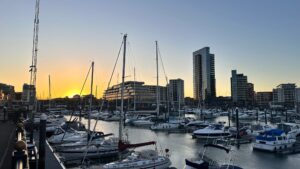
Mayflower Park
- Location: Waterfront along Town Quay Road.
- Key Advantage: Wide, unobstructed views looking west across Southampton Water toward the New Forest.
- Facilities: Expansive lawns, paved promenades, and plenty of space for spectators.
Weston Shore
- Location: Coastal promenade along the eastern side of the Solent.
- Key Advantage: Uninterrupted views over the water facing west toward Hythe.
- Facilities: Long beachside walk with dedicated roadside parking bays.
Town Quay
- Location: Central waterfront near the Isle of Wight ferry terminals.
- Key Advantage: Elevated boardwalk views across the water facing west-northwest.
- Facilities: Close to city centre amenities and public transport links.
Other places with a clear western view
- Southampton Common: Elevated open fields near the centre of the park (stay clear of tall tree lines).
- Hythe Pier & Waterfront: Panoramic western views looking back across Southampton Water via the Hythe ferry.
- Calshot Spit: Wide open coastal horizon with no building obstructions.
Where to Buy Solar Eclipse Glasses
Looking directly at the Sun without specialised protection causes permanent eye damage within seconds. Regular sunglasses, even dark polarised models, do not protect your eyes.
Where to buy solar eclipse glasses in Southampton
- Local Science Centres: Winchester Science Centre and local planetariums stock certified eclipse viewers leading up to major events.
- Opticians & Photography Stores: Select high-street opticians and camera outlets across Hampshire stock solar glasses.
- Online Astronomy Retailers: Reputable UK astronomy suppliers offer certified glasses with fast delivery options.
What to look for when buying eclipse glasses
Safety Verification Checklist
- ISO 12312-2 Certification: Ensure the glasses explicitly state compliance with international ISO 12312-2 safety standards.
- CE / UKCA Marking: Check for official safety compliance marks printed on the cardboard frames.
- Undamaged Filters: Inspect the dark polymer lenses before use; if there are scratches, pinholes, or tears, discard them immediately.
- Reputable Manufacturers: Only buy from verified manufacturers listed by recognised astronomical bodies.
Can you use normal sunglasses?
No, standard sunglasses are not safe for solar viewing. Important safety facts:
- Transmits too much light: Sunglasses allow thousands of times too much solar radiation to pass through.
- No invisible radiation block: They do not block harmful infrared and ultraviolet rays.
- Risk of blindness: Looking at the Sun through sunglasses can cause permanent retinal burns.
How to Watch the Solar Eclipse Safely
How to use solar eclipse glasses
- Inspect the glasses: Check the lenses for scratches, pinholes, or tears before use.
- Put them on correctly: Turn away from the Sun, fit the glasses securely over your eyes, and then look up.
- Keep them on: Never remove the glasses while looking directly at the solar disc.
- Look away to remove: Lower your gaze toward the ground before taking the glasses off.
Can you use a phone or camera to photograph the eclipse?
Do not look at the Sun through camera viewfinders, smartphones, binoculars, or telescopes while wearing eclipse glasses. Key rules for solar photography:
- Filter requirement: You must attach a certified solar filter over the front lens of the camera or phone.
- Risk to equipment: Concentrated sunlight can melt phone camera sensors and lenses.
- Risk to vision: Optical lenses magnify solar rays and will instantly burn through cardboard eclipse glasses.
Can children watch the eclipse?
Yes, children can watch the eclipse safely under strict adult supervision:
- Ensure proper fit: Check that eclipse glasses fit closely on smaller faces without slipping.
- Direct supervision: Make sure children do not remove their glasses while looking at the Sun.
- Alternative method: Use a pinhole projector made from two pieces of card to project the crescent image onto the ground safely.
What Direction Should You Look for the Eclipse?
To view the eclipse from Southampton, face toward the West-Northwest (bearing 280° on a compass). Key directional factors include:
- Compass Bearing: 280° West-Northwest.
- Elevation: Approximately 11 degrees above the horizon at maximum peak (7:14 PM).
- Obstruction Check: Ensure your sightline is free from multi-storey buildings, high trees, or harbour structures.
What Will the Solar Eclipse Look Like From Southampton?
Because Southampton will experience a 93% partial eclipse, you can expect several distinct visual features:
- Crescent Sun: The Sun will appear as a very thin, bright fingernail of light.
- Dimmed Daylight: Natural daylight will drop noticeably, creating an unusual twilight ambiance.
- Sharp Shadows: Ambient shadows cast on pavements will appear remarkably sharp and defined.
- Crescent Pinhole Shadows: Sunlight filtering through tree leaves will project hundreds of tiny crescent shapes onto the ground.
What If It Is Cloudy in Southampton?
Even if coastal cloud cover obscures the direct crescent of the Sun, you will still experience the environmental effects of the event:
- Daylight Drop: The sky will still darken significantly around peak time (7:14 PM).
- Temperature Change: You will feel a slight drop in air temperature as the Moon blocks solar energy.
- Moving Locations: Monitor live satellite weather maps on the day to move to clearer coastal spots if needed.
Exploring Southampton Attractions?
If you are visiting the city for the eclipse and want to discover great local parks, historic sites, and waterfront destinations, explore our guide to places in Southampton to help plan your visit.
Final Thoughts
The August 2026 solar eclipse promises to be an unforgettable event for Hampshire residents. To make the most of the spectacle:
- Choose a clear spot: Head to waterfront locations like Mayflower Park or Weston Shore for clear western views.
- Get safe viewers: Secure ISO 12312-2 certified eclipse glasses well in advance.
- Track the times: Be in position before the partial eclipse begins at 18:18 BST.
Solar Eclipse 2026: Frequently Asked Questions
What time is the solar eclipse in Southampton?
The partial eclipse begins at 18:18 BST (6:18 PM), reaches maximum coverage at 19:14 BST (7:14 PM), and concludes at 20:07 BST (8:07 PM).
Is the 2026 solar eclipse visible from Southampton?
Yes, Southampton will see a major partial solar eclipse with up to 93% of the Sun covered by the Moon.
Where is the best place to watch the eclipse in Southampton?
Open waterfront spots with unobstructed views to the West-Northwest, such as Mayflower Park, Weston Shore, and Town Quay, are ideal.
Where can I buy solar eclipse glasses?
Certified ISO 12312-2 eclipse glasses can be purchased online from verified astronomy suppliers, science centres, or optical stores prior to the event.
Can I watch a solar eclipse without glasses?
No, looking directly at a partial solar eclipse without certified solar protection causes permanent eye damage. Standard sunglasses are not safe.
What direction should I look for the eclipse?
Look toward the West-Northwest (280°), approximately 11 degrees above the horizon at peak time.
Is the 2026 solar eclipse a total eclipse in Southampton?
No, it is a deep partial eclipse in Southampton. The path of 100% totality lies further south across Iceland and Spain.